


Certified Athletic Trainers To Host Concussion Talk March 25
Wittenberg's certified athletic trainers will host Lunch and Learn event to dispel misconceptions about concussions on March 25 in Shouvlin Center.
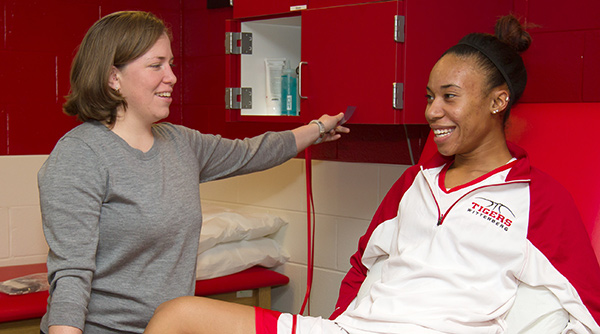
Certified Athletic Trainer Molly Hopkins counsels a Tiger student-athlete in the Kremcheck Family Training Room.
File Photo | Erin Pence
Springfield, Ohio – Concussions are a hot topic in the medical community, and March is National Athletic Trainers Month and Brain Injury Awareness Month. In recognition of that symmetry and in an effort to end misconceptions about the injury, Wittenberg University’s certified athletic training staff will host a Lunch and Learn event at 12 p.m. Tuesday, March 25, in Room 105 of the Joseph C. Shouvlin Center for Lifelong Learning.
The Lunch and Learn event is offered free of charge and is open to the general public. Participants should bring their own lunch. Beverages and cookies will be provided. To register, contact Head Certified Athletic Trainer Ellen Crosbie by email at ecrosbie@wittenberg.edu by Wednesday, March 19.
Wittenberg’s certified athletic trainers have already treated 40 student-athletes for concussions in the 2013-14 school year. These injuries are associated most often with contact sports like football and men’s lacrosse, but the reality is that concussions occur in many sports not with limited physical contact.
“We want to collaborate with the Wittenberg staff and faculty on the misconceptions about concussions and how to effectively work with the student-athlete who has suffered a concussion,” said Wittenberg University’s Head Certified Athletic Trainer Ellen Crosbie. “We want them to understand they are a part of the team approach to help the ‘student’ in the student-athlete.”
A concussion is a brain injury that affects the body’s brain-induced biomechanical forces. A concussion can be sustained by a direct blow to the head, face, neck, or elsewhere with an ‘impulsive’ force transmitted to the head, which usually results in short-lived impairment of neurologic function. Some concussions can result in a loss of consciousness.
Crosbie said that misconceptions about concussions occur mostly due to a lack of education. For example, many people believe that that a concussion is only sustained following a blow to the head, but the truth is that an impact anywhere on the body can cause the head to snap and create a “whiplash effect” that causes the brain to shift and hit against the skull.
“Symptoms of concussions are usually immediate,” Crosbie said. “There are some exceptions. Some of the signs aren’t obvious at first, but there are many signs of a concussion, including headache, nausea, vomiting, balance problems, dizziness, fatigue and trouble falling asleep.”
Another misconception is that an MRI or a CAT Scan is necessary to diagnose a concussion. Neither medical test is necessary to diagnose a concussion, although both can be used to detect other serious neurological illnesses, such as a subdural hematoma.
Crosbie also plans to address the myth that boys get more concussions than girls.
“Females have a much higher rate in basketball and soccer,” Crosbie said. “Studies show the recovery time for females is longer, as well.
“These misconceptions can lead to difficulty in doing our job. We stress to all student athletes to be honest with all their injuries, not just concussions. We want to focus on the whole student athlete, not just the athlete component of the student.”
Crosbie added that honesty is the best policy when it comes to managing a concussion, or any injury for that matter. A problem all certified athletic trainers encounter is that student-athletes will sometimes lie so they can return more quickly to participating in their sport, or they may lie about the injury or their symptoms altogether.
It is impossible to determine how each person will react to a concussion because all concussions have different levels of severity, lasting effects, and future deficits which are all hard to predict. So Wittenberg’s certified athletic trainers have developed a policy to treat student-athletes and ensure their safety upon returning to field.
“All student-athletes follow our concussions policy,” Crosbie said. “It allows the student-athletes to heal on their own pace. Some may experience minor symptoms and return to play in seven to eight days. Others experience symptoms that can linger, missing two weeks to even season-ending concussions. If they are too concussed to go to class, they are too concussed to play.”
The Lunch and Learn will also include a discussion of rehabilitation techniques led by Sue Kreger, a physical therapist with Excel Sports Medicine. To determine “return to play criteria,” student-athletes are required to take a neurocognitive test prior to playing their sport. This is the baseline test that tests multiple brain functions such as memory, problem solving, reaction times, brain processing speeds, and post-concussion symptoms.
Written By: Caroline Eldridge
'14